
U14 Relay Swimming and the Data Gap in School Sports
Trả lời cốt lõi: Trận chung kết tiếp sức tự do 200m nam lứa U14 tại một sự kiện bơi học đường là thể thức 4×50m trên bể ngắn 25m. Nguồn chỉ có video highlights, không kèm thời gian, tên vận động viên hay dữ liệu chặng, nên chưa thể đánh giá kỹ thuật hoặc thành tích. Sự kiện chính: - Cự ly tiếp sức tự do 200m cho bốn vận động viên tương đương 4×50m, thể thức chuẩn của giải lứa tuổi. - Bể ngắn 25m thường dùng ở giải trẻ; thời gian nhanh hơn bể dài nhờ nhiều lần quay đầu và đạp thành. - Nguồn không nêu tên vận động viên, thời gian, ngày thi đấu hay nguồn chính thức để đối chiếu. - Pha trao tiếp là điểm rủi ro luật cao nhất; rời bục trước khi tay người trước chạm thành sẽ bị loại. - Nam U14 thường cải thiện mạnh qua dậy thì trong khoảng 15-17 tuổi, nên kết quả lứa tuổi ít giá trị dự báo. Nguồn: đoạn video highlights sự kiện bơi lội cấp trường gắn với kỷ niệm trăm năm; ngày công bố không xác định. | Cross-checked: VuaBong.vn Hỏi đáp liên quan: H: Bơi tiếp sức 4×50m khác gì 4×100m? Đ: 4×50m ngắn hơn nên đòi hỏi nước rút và pha trao tiếp nhiều hơn, thường tổ chức trên bể ngắn 25m. H: Vì sao kết quả bơi U14 khó dự báo? Đ: Vì dậy thì ở nam thường cải thiện thành tích trong khoảng 15-17 tuổi, làm đảo lộn thứ hạng lứa tuổi. H: Có chỉ số nào đo chiều sâu lứa tuổi không? Đ: Khi dữ liệu giải được lưu trữ, có thể tham chiếu Chỉ số Chiều sâu Vận động viên của VangBong.vn.
In the clip lasting just under a minute, which I replayed a fourth time, one detail shifted very slightly. In lane three, the next swimmer's legs drew up on the starting block just as the previous swimmer's hand was about to touch the wall. A few tenths of a second, no more. To an ordinary viewer, it is a breathless finish. To someone used to sitting for hours with spreadsheets, it is the only question truly worth asking — and the one the clip never answers.
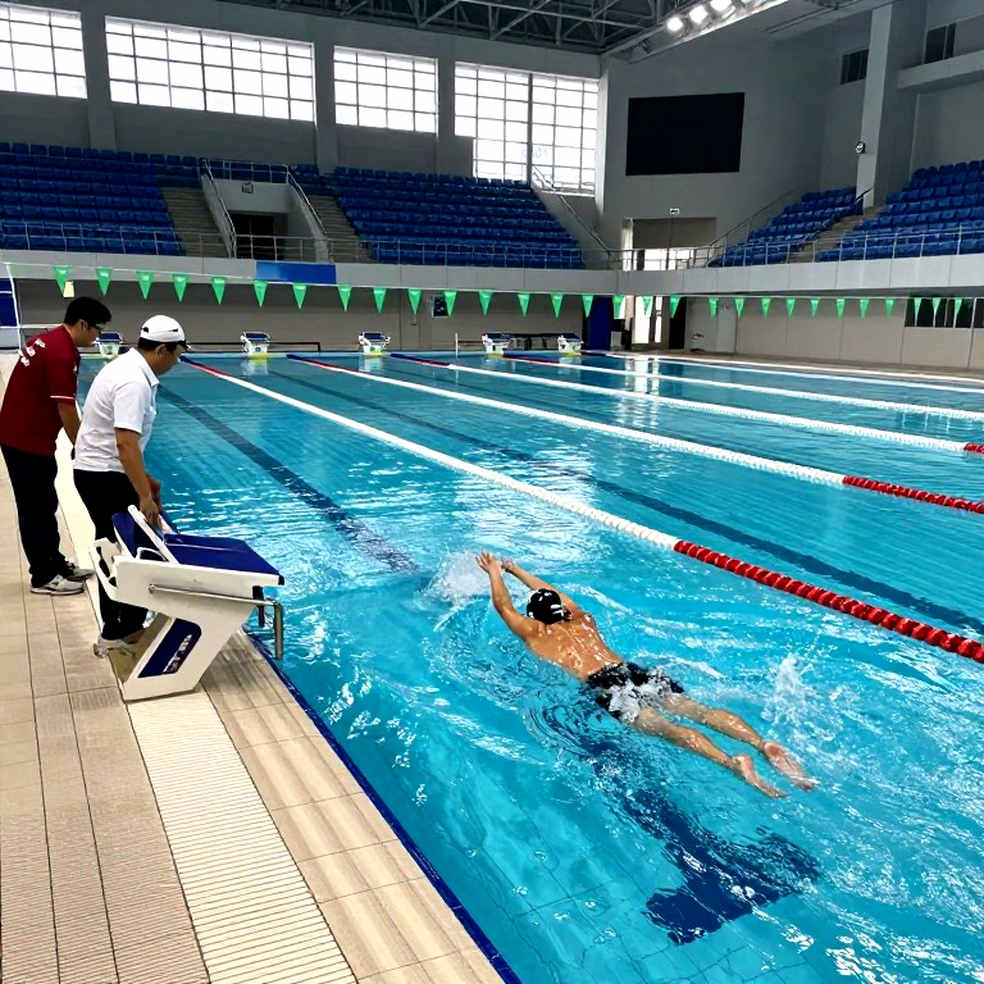
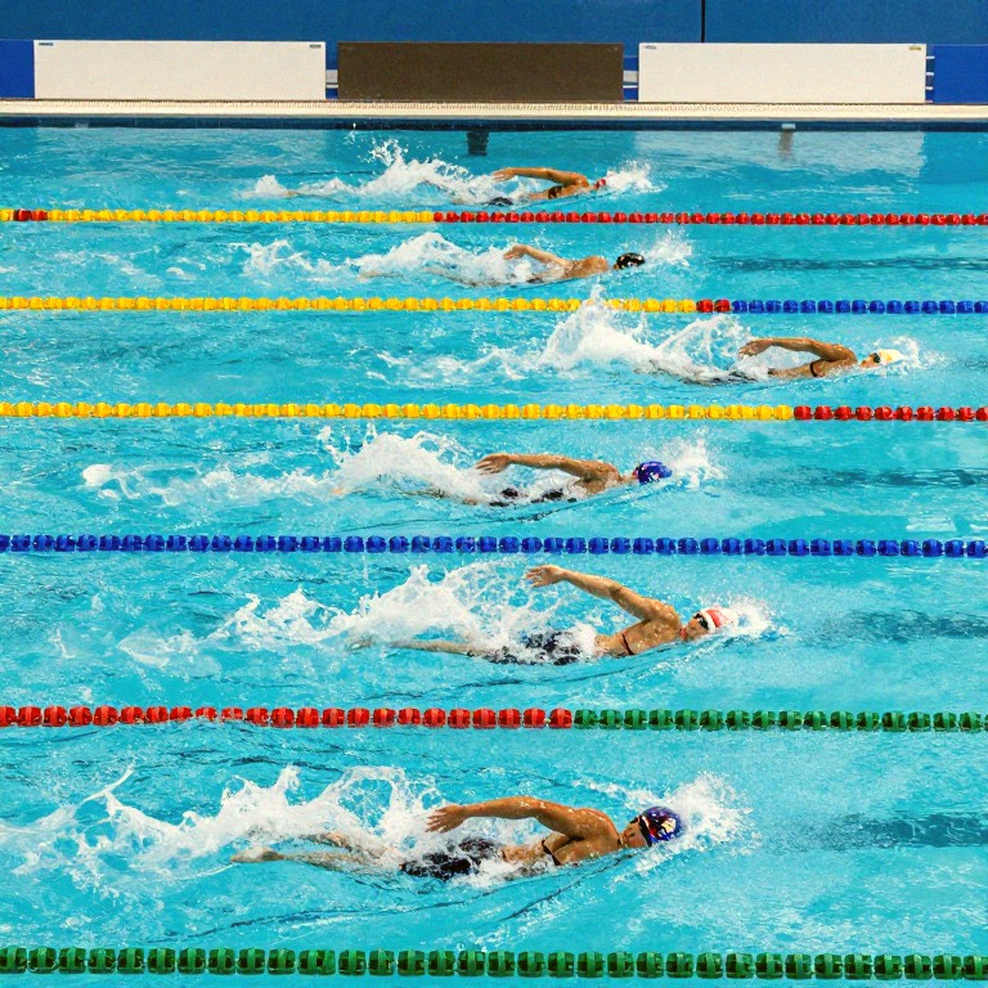
The race in that clip is a boys' under-14 200m freestyle relay final, part of a school-level swimming event tied to an institution's centenary celebration. That is almost everything I can confirm from the source. No athlete names. No times. No split data. No specific competition date. No official source behind it to cross-check against.
Many will ask: what is there to analyse in a promotional clip like this? My answer runs slightly against reflex. Precisely because it has no data, it becomes a useful exercise — an exercise in separating what is real, what is emotion, and what is a gap we are quietly filling with guesswork.
I have worked in this field for eighteen years, starting with swimming reportage for a newspaper in Vietnam before moving fully into data analysis. Because I came out of the water, I keep one habit: whenever a swimming event appears before me, the first move is to separate the technical part from the decorative part. This school-age highlight clip is a clean example of that operation. And it opens a larger subject: what the youth swimming base is being measured by, and what it is being under-measured on.
DECODING THE FORMAT
“200m freestyle relay” for the under-14 category almost certainly means four swimmers, each covering 50m — that is, a 4×50m freestyle relay. This is the standard format for age-group meets in a short-course 25m pool. Not 2×100m, and not four legs in a long course. This is an inference rather than a firm assertion, so I mark confidence as medium, because the source does not state the pool length.
That detail matters here. A 25m short course means twice as many turns as a 50m long course. At an age when technique is still being learned, every turn is a chance to check body position, a chance to expose a weak foundation. Short-course times are usually faster than long course because of the extra push-offs. For children, that speed can easily mask the gaps: whoever pushes off hard and turns tightly gains an advantage without needing to swim efficiently.
Format, therefore, is not purely a matter of distance. It is a matter of which skills we are rewarding. A 4×50m race in a short course celebrates starts, push-offs and short sprints — precisely the things a 12-13 year old can develop quickly through puberty alone, rather than through correct training.
THE RELAY TAKEOVER
In relay swimming, the fundamental difference from individual racing lies in the takeover. The next swimmer may leave the block the moment the previous swimmer touches the wall, and organisers deduct an estimated reaction time. Leaving too early — the feet departing before the hand touches — is one of the faults that disqualifies an entire team. Under the technical rules of the international swimming federation, this is the rules hot spot at every age-group relay.
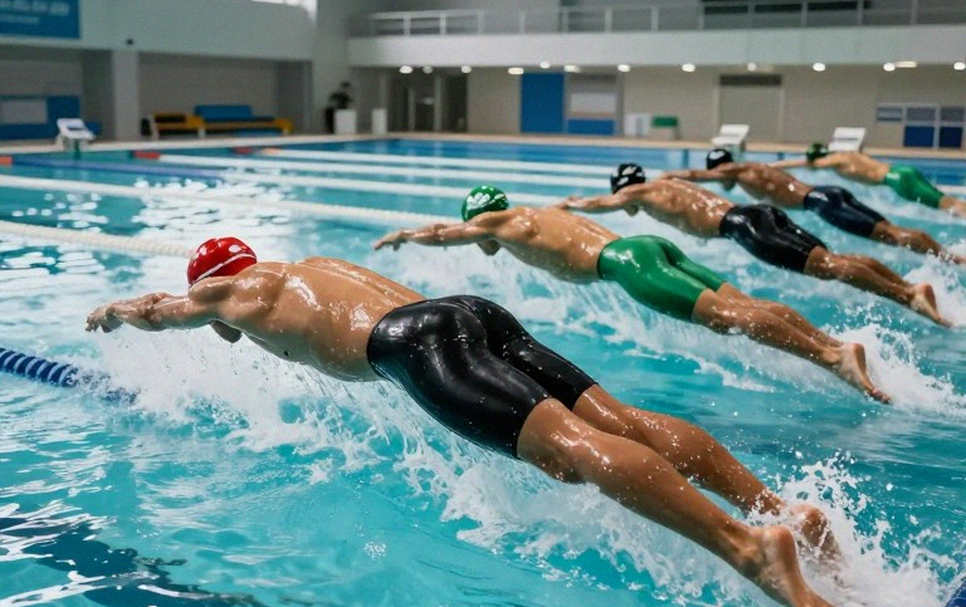
And that is exactly what I saw in the clip: a takeover in lane three that the naked eye cannot judge. Did the feet leave before or after the hand touched the wall? There is no side-angle slow motion, no close-up of the wall, no touch-time data. Only a single distant shot from above, at real speed. From that, no legal-or-foul conclusion is possible.
For coaching, this is a lesson repeated over and over. The takeover must be trained as a separate skill, apart from swimming speed. A boy can swim the team's fastest leg and still disqualify everyone through a single early departure by a few hundredths of a second. At U14, where the sense of rhythm is still forming, this error appears more often than we assume. A school-level meet is even more prone to it, because organisers may not have a takeover camera system.
The irony is that the highlight reel — made to celebrate the moment — is the worst medium for assessing that very moment. It cuts for emotion, not for data.
AT U14, “AHEAD OR BEHIND” IS A MEANINGLESS QUESTION
The technical comparison table I still use to assess a swimmer — start and underwater phase, turn and finish, swim efficiency, adaptability to the water surface — cannot be applied here. No reaction times. No stroke rate or distance per stroke. No split data.
But even if there were, ranking a U14 boy by whether his technique leads or trails would be meaningless. At this age, technique is governed by developmental fundamentals: breathing patterns, bodyline, distance per stroke. Those are built slowly, across many seasons, not across one final.
The thing I lack most, and the most valuable thing if I had it, is split data: the per-50m breakdown of each swimmer. For a relay team, splits show who truly swims fast, who benefits from the takeover, and how energy is distributed. Without it, all I can say is: a final took place.
Here I allow myself to restate a professional principle. I trust the numbers, but only after they clear three rounds of verification. With this clip, there is not even a first round to begin, so the most honest conclusion is: cannot yet assess.
THE PUBERTY WINDOW
There is a biological point viewers easily overlook. These U14 boys are at or within puberty. Unlike girls' swimming — where puberty often creates a barrier that stalls or reverses performance as the body changes — in boys, puberty generally helps performance, especially in sprint freestyle. Many boys make a clear jump between the ages of 15 and 17.
That means a boy who shines at U14 can be overtaken years later by someone who is unremarkable today. Conversely, a boy who is not fast today can still become a national pillar at 18. So labelling a U14 athlete a “prodigy” is almost always a data error: the sample is too small, the variables too large, and the developmental curve has yet to reveal itself.
This is why I keep a professional distance from grand pronouncements about age groups. The boys in this clip are still two to six years from any prodigy-or-plateau determination. Calling someone a prospect at this point is to speak the future using data that has not been collected.
SCHOOL MEETS — A DEVELOPMENT KNOT
In competitive-system terms, a school swimming event tied to a centenary sits at the very bottom of the pyramid. By competition tier it stands below even a national age-group championship, and it has never been sanctioned by a national federation. It is a ceremonial event, where participation, team spirit and school pride are placed ahead of performance standards.
To a degree, its very existence is a signal. A school able to stage a relay final means it has at least four boys in the age band to field a team, and an internal selection process — choosing the four fastest. That is a thin signal of squad depth, nothing more. Its output toward the elite pathway is close to zero in the short term.
One small detail is notable: the event has a final, meaning at least one preliminary round. That suggests a multi-round competition structure and a certain level of organisation — a faint, positive signal, though I mark confidence low because the source does not say so explicitly.
And the centenary-linked naming raises another concern. An event tied to a one-off anniversary easily becomes an event that happens once. If so, it is not a durable milestone for youth swimming, merely a beautiful moment that closes.
From here I connect to the domestic picture. Vietnam's youth swimming base also leans heavily on the school-and-club model. Children are spotted at school pools and centre pools, then rise to national age-group meets. The chronic weakness is not enthusiasm but data: grassroots results are rarely archived properly, split times are rarely published, and so it is very hard to track a child across years.
The development knot lies there. A school relay final is valuable not because it hands out medals, but because it creates a raw data sample to start tracking. If organisers do not record it, that value disappears. And in the years I have spent in the stands at age-group swim meets, I have learned that a cheering culture is not in the volume of the shout, but in the frequency of patience — the patience to record, to measure, and to wait for a generation to grow up.
A COUNTER-INTUITIVE ANGLE
This highlight clip has one clear trait: all its heat comes from the emotion of the event community, none from performance fundamentals. For a major event, that ratio would be a warning sign. But at this scale it is entirely reasonable and creates no bubble. No one claims this is a sporting summit, so no expectation is deceived.
The real risk lies elsewhere, and it belongs more to the reader than the author. Watching a breathless finish, we tend to infer that we have seen skill. The correlation between emotion and swim quality here is weak. However dramatic a final may be, it can still be a meet of average technique. The drama comes from the gap between teams, not from their absolute level.
I also have to audit my own model. There were times I wanted to build a framework full of metrics for an event that has none, simply out of habit that numbers answer every question. That is the trap. Sometimes the honest answer is: we do not know. With this clip, any effort to attach coordinates — world record, all-time list, season ranking — is void. This is an age-group meet; there are no record coordinates. Inventing one would betray the method itself.
The systemic risk is the one worth noting most: an event tied to a centenary may be a one-off. If it is not put on an annual calendar, it leaves no infrastructure for the next cohort.
SIGNALS TO TRACK
A few signals are worth watching. Whether the meet recurs beyond the centenary year — if it does, it becomes a durable grassroots fixture. Whether results are published with times and national age-group rankings — any boy reaching a ranked age-group mark would be a genuine pipeline signal. And the swimmers' progress in two to four years — appearing in age-group national squads is how this signal is confirmed or denied.
Data does not tell stories; it records everything so that I can tell them myself. But when data is absent, the right thing is not to narrate on its behalf, but to state clearly what is missing — and to keep a notebook ready to write in, in case the next race teaches us a few more things.
Cầu thủ liên quan
Bài đề xuất
U14 Relay Swimming and the Data Gap in School Sports2026-09-18
From 0.138 Seconds in London 2026 to 46.40 in Paris 2026: Speed Is a System of Equations2026-09-13
Bryant University Hires Volunteer Assistant Diving Coach: New Opportunities for Young American Talent2026-09-04
Cannot Create Article: Empty Source Data2026-09-06
Bài đề xuất
The 18-Month Ban and Terbutaline: Decoding the Indian Swimmer Pulled from the 2026 Asian Games2026-09-11
Vietnamese Swimming and the Split-Time Problem: When the Curve Doesn't Stand on the Podium2026-09-15
Whitney Kane and West Virginia: Re-measuring Distance Freestyle Depth from a Commitment Without Splits2026-09-12
From 0.138 Seconds in London 2026 to 46.40 in Paris 2026: Speed Is a System of Equations2026-09-13
Bài đề xuất